Please support my latest project:
http://www.indiegogo.com/Re-Mapping-Our-histories?i=pite
this is an amazing project and I've only raised $100 of my $3000 goal with 54 days left to get the rest!
check it out! (i promise itll be worth it)
and remember a $15 dollar donation will secure you a limited edition re-mapping our (his)Stories t-shirt!
Wednesday, August 18, 2010

Tuesday, August 17, 2010

Sunday, August 8, 2010




Thursday, July 1, 2010
Launching The Midnight Media Coup and the Re-Mapping Our (his)Stories Project
http://midnightmediacoup.webstarts.com
Friday, April 30, 2010
Artist Statement?
here it is! ( i think )
The Trek Project is the culmination of a journey. For me this project has been an experiment, an investigation, an interrogation. Creating this project has sent me into some of the most uncomfortable places in my soul; time spent interrogating systems of oppression that I have both opposed but also supported. Examining all of this I repeatedly asked myself what is my stake in all of this? Who am I to create this story?
It is a question that this movie does not answer, rather it pushes it further, complicates the lines of borders, travel and story. I created this project to give back to an organization that has given me endless opportunity and perspective. What I give to you, the viewer, is a piece of this, a piece of the journey and a chance for perspective. What will you do with it?
The Trek Project is the culmination of a journey. For me this project has been an experiment, an investigation, an interrogation. Creating this project has sent me into some of the most uncomfortable places in my soul; time spent interrogating systems of oppression that I have both opposed but also supported. Examining all of this I repeatedly asked myself what is my stake in all of this? Who am I to create this story?
It is a question that this movie does not answer, rather it pushes it further, complicates the lines of borders, travel and story. I created this project to give back to an organization that has given me endless opportunity and perspective. What I give to you, the viewer, is a piece of this, a piece of the journey and a chance for perspective. What will you do with it?
Sunday, March 21, 2010
DONE
ok, so, its about 2 months late, buuuuut, the editing of El Trompo is done!
the video will be ready to screen soon, all that has to happen is final sound editing and subtitles.
ALSO The Trek Project itself is also almost done!
one of the big barriers to completing the project is that I need to work on the timeline of US Latin American History and make it more graphically appealing, you can see the timeline in the previous post, if anyone has any ideas/drawings they think would work well with the timeline send them along!
Hopefully the next few weeks will go smoothly and the piece will be screening and released soon!
the video will be ready to screen soon, all that has to happen is final sound editing and subtitles.
ALSO The Trek Project itself is also almost done!
one of the big barriers to completing the project is that I need to work on the timeline of US Latin American History and make it more graphically appealing, you can see the timeline in the previous post, if anyone has any ideas/drawings they think would work well with the timeline send them along!
Hopefully the next few weeks will go smoothly and the piece will be screening and released soon!
Tuesday, February 16, 2010
3rd and (almost) Final Cut
Last sunday I finished the last major rough cut of El Trompo, it is posted on vimeo:
http://vimeo.com/9503078
or below:
the password is the same as the last two times and if you don't know it just email me (hhconnects@gmail.com) or Facebook me and I will let you know.
Also as far as the rest of the project is concerned I am posting the rough version of the timeline below:


As you can probably guess production has been pushed back a little farther than I originally intended. However, I promise it will be worth it!
http://vimeo.com/9503078
or below:
3rd Cut El Trompo Best Quality from Helyx Chase on Vimeo.
the password is the same as the last two times and if you don't know it just email me (hhconnects@gmail.com) or Facebook me and I will let you know.
Also as far as the rest of the project is concerned I am posting the rough version of the timeline below:


As you can probably guess production has been pushed back a little farther than I originally intended. However, I promise it will be worth it!
Wednesday, February 3, 2010
Translations
Since the beginning TTP has presented me with a language barrier. My Spanish is conversational at best but I tend to understand a lot more than I can speak. In some sense I started preparing to travel to Nicaragua in January of 2009 when I traveled to Guatemala to take a 2-week Spanish intensive. Before I went buildOn requested that while I was in Nicaragua I hire a translator to accompany me so that I would not monopolize the program translators. My plan had been to only use buildOn’s translators for straight on interviews but I agreed to hire the translator despite the strain it put on my budget. On my first day in Nicaragua I met Javiera, we lived together for 2 weeks with our host family, slept in the same bed and were together for almost 24 hours a day. We grew quite close and I found her to be valuable in many more ways than I anticipated entering this project.
While in Nicaragua Javiera would joke that I didn’t even need her. I could generally understand what people told me during interviews and in my own conversations. However, having a translator I discovered became of great benefit to me when it came to speaking and translating my ideas into something that the people in the community could understand. While I can speak some Spanish, my grammar is rather awful and there are dialectic nuances within Nicaraguan Spanish that I do not know. Javiera was able to help me navigate that space.
When I returned to the States to edit the documentary I used only the recordings of translations on the tape and relied mostly on my own Spanish to edit down interviews, etc. I made an agreement with a friend who agreed to write up subtitles for me which has given me concrete translations from a Spanish speaker.
However, as I edit the piece I often find that the in-country translators tended to simplify the words of the community members. I listen to the community members speak and find power in the words and phrases they choose to repeat and the way that they repeat them, however, when our translators repeated the sentiments in English for the team they tended to leave out those repetitions and miss the intonations of the speakers. Additionally, while conducting interviews with my translator I found that she would often not translate sentences when she thought that they were not responding to the question in the way that I wanted them to.
As I move into final cuts I am left with one problem. How do I translate? My intention from the beginning is that the entire piece should be bi-lingual. There is no need in my mind to have a Spanish version and an English version. Additionally, the community in which I shot the documentary has many residents who are illiterate. My preference is that the entire piece should have spoken translations for all of the English and preferably the Spanish as well, because it is certainly unfair to assume literacy in the US as well. The piece I feel should be accessible to as many people as possible, when education and literacy present such a huge barrier to understanding “academic” concepts I do not want to continue this problem of academic/educational elitism.
And yet as I struggle to complete the piece I run into the technicalities of using that many double translations. To have everything spoken in both languages could potentially almost double the length of the piece, and I fear that it will not be able to sustain the increased length. Writing this reminds me why I want to, and need to continue to translate and make the piece accessible, and yet how do I make this all work?
While in Nicaragua Javiera would joke that I didn’t even need her. I could generally understand what people told me during interviews and in my own conversations. However, having a translator I discovered became of great benefit to me when it came to speaking and translating my ideas into something that the people in the community could understand. While I can speak some Spanish, my grammar is rather awful and there are dialectic nuances within Nicaraguan Spanish that I do not know. Javiera was able to help me navigate that space.
When I returned to the States to edit the documentary I used only the recordings of translations on the tape and relied mostly on my own Spanish to edit down interviews, etc. I made an agreement with a friend who agreed to write up subtitles for me which has given me concrete translations from a Spanish speaker.
However, as I edit the piece I often find that the in-country translators tended to simplify the words of the community members. I listen to the community members speak and find power in the words and phrases they choose to repeat and the way that they repeat them, however, when our translators repeated the sentiments in English for the team they tended to leave out those repetitions and miss the intonations of the speakers. Additionally, while conducting interviews with my translator I found that she would often not translate sentences when she thought that they were not responding to the question in the way that I wanted them to.
As I move into final cuts I am left with one problem. How do I translate? My intention from the beginning is that the entire piece should be bi-lingual. There is no need in my mind to have a Spanish version and an English version. Additionally, the community in which I shot the documentary has many residents who are illiterate. My preference is that the entire piece should have spoken translations for all of the English and preferably the Spanish as well, because it is certainly unfair to assume literacy in the US as well. The piece I feel should be accessible to as many people as possible, when education and literacy present such a huge barrier to understanding “academic” concepts I do not want to continue this problem of academic/educational elitism.
And yet as I struggle to complete the piece I run into the technicalities of using that many double translations. To have everything spoken in both languages could potentially almost double the length of the piece, and I fear that it will not be able to sustain the increased length. Writing this reminds me why I want to, and need to continue to translate and make the piece accessible, and yet how do I make this all work?
Sunday, January 24, 2010


Wednesday, January 20, 2010
Thoughts on Aide Tourism
many well intentioned westerners enter the community thinking that they have all the answers. This community is strong, it existed before we came and it will continue to exist after we leave.
why must we always transplant our ideas on others, disregarding the answers they came up with themselves.
we live in a country with the largest wealth gap of any developed nation. Many of our children may graduate high school, but how many still cannot read? How many come out not knowing how to learn but only knowing how to perpetuate the machine.
everyday organizations from the US travel abroad and continue to support the colonialism the government. We have been brainwashed to see others as helpless, to see our privilege as the savior and to see our systems as superior, but are they really?
why must we always transplant our ideas on others, disregarding the answers they came up with themselves.
we live in a country with the largest wealth gap of any developed nation. Many of our children may graduate high school, but how many still cannot read? How many come out not knowing how to learn but only knowing how to perpetuate the machine.
everyday organizations from the US travel abroad and continue to support the colonialism the government. We have been brainwashed to see others as helpless, to see our privilege as the savior and to see our systems as superior, but are they really?
Thursday, January 14, 2010
I create this project to tell a story. A story that can be compared to the millions of other similar stories, but also one that is completely rooted in the unique history of one specific community. This story is, I hope, a piece that pays dignity and respect to it's subjects in a way that continually challenges and pushes my reality. I am not a voice of authority or vast knowledge. I speak as an observer, an outsider. There is no quick fix to the problems that I present. However, my hope is that with more awareness we can re-think the way we see ourselves, and within that, how we see others.
Thursday, January 7, 2010
Home Stretch = January
to do list for january:
FINISH The Trek Project
this means completing the editing of El Trompo
creating the map/timeline of Latin America
compiling the maps from the mapping workshops
finishing a documentation notebook of the entire project from October 2008 - January 2010
There is a second rough cut of El Trompo on vimeo-
http://vimeo.com/8583078
the password is the same as last time, if you want it email me at hhconnects@gmail.com
ALSO I am proud to present the *almost* final trailer for El Trompo,
check it out:
FINISH The Trek Project
this means completing the editing of El Trompo
creating the map/timeline of Latin America
compiling the maps from the mapping workshops
finishing a documentation notebook of the entire project from October 2008 - January 2010
There is a second rough cut of El Trompo on vimeo-
http://vimeo.com/8583078
the password is the same as last time, if you want it email me at hhconnects@gmail.com
ALSO I am proud to present the *almost* final trailer for El Trompo,
check it out:
Tuesday, November 10, 2009
What does a Colonizer Look Like?
There are 4 elements at play in the definition of a country as a colonial power over another:
(1) the economic: appropriation of land, exploitation of labor, and control of finance; (2) the political: control of authority;
(3) the civic: control of gender and sexuality;
(4) the epistemic and the subjective personal: control of knowledge and subjectivity.
With regards to the US and Latin America the United States has some hand, if not a full fist, in all of these areas. I have started reading the book The Colonizer and the Colonized by Albert Memmi. The first section of the book attempts to define and depict the colonizer.
"Today, leaving for a colony is not a choice sought because of its uncertain dangers, nor is it a desire of one tempted by adventure. It is simply a voyage towards an easier life." Memmi goes on to describe the colonizer as one who leaves their country not simply for adventure, because if that was the case why would they not go somewhere among their own country men? "Our traveler will come up with the best possible definition of a colony: a place where one earns more and spends less". As he goes on it descibes the difficulty for a colonizer to leave the colony. After a few years returning to the "slow progress" of home, and more expensive lifestyle is no longer appealing. Additionally the colonizer has laid roots in their new home, and lost roots in their old one. Why should the colonizer then leave the colony, especially when their privilege makes life in the colony easier then it would have been in the home country.
This perspective on the colonizer brings me back to the expatriate community that I saw when I was in Guatemala last January. For the most part the people I met were white US citizens who for one reason or another (primarily political) had decided to leave the United States. While I understand the desire to leave the United States out of frustration, I also feel the need to stay out of loyalty and obligation to my people. One of the fellow students at the Spanish school where I was taking classes mentioned to me that all the expatriates there seemed to be lost. To me the idea of leaving the US in political protest seems to be in vein. First off, no change can come from a few individuals, that were likely to radical for the government anyway, leaving. Secondly, their efforts to escape the US government may as well be void because they have moved to a place that is, in many crucial ways, a colony of the US, or at the very least a place that the US holds colonial power over.
In his book, Memmi describes 3 types of individuals in the colonizer/colonized relationship. They are the colonial, the colonizer and the colonist. The colonial is described as a European (or for our purposes one from the United States) living in the colony but having none of the privileges of their position. "a colonial is a benevolent European who does not have the colonizers attitude towards the colonized", in the next sentance Memmi goes on to say "a colonial so defined does not exist, for all Europeans in the colonies are privileged".
What I am attempting to begin to examine here is what is the role and power that one posses in moving to an expatriate community in Latin America. How can one move in an effort to escape the imperialistic policies of the US while simultaneously re-enforcing that colonialism.
(1) the economic: appropriation of land, exploitation of labor, and control of finance; (2) the political: control of authority;
(3) the civic: control of gender and sexuality;
(4) the epistemic and the subjective personal: control of knowledge and subjectivity.
With regards to the US and Latin America the United States has some hand, if not a full fist, in all of these areas. I have started reading the book The Colonizer and the Colonized by Albert Memmi. The first section of the book attempts to define and depict the colonizer.
"Today, leaving for a colony is not a choice sought because of its uncertain dangers, nor is it a desire of one tempted by adventure. It is simply a voyage towards an easier life." Memmi goes on to describe the colonizer as one who leaves their country not simply for adventure, because if that was the case why would they not go somewhere among their own country men? "Our traveler will come up with the best possible definition of a colony: a place where one earns more and spends less". As he goes on it descibes the difficulty for a colonizer to leave the colony. After a few years returning to the "slow progress" of home, and more expensive lifestyle is no longer appealing. Additionally the colonizer has laid roots in their new home, and lost roots in their old one. Why should the colonizer then leave the colony, especially when their privilege makes life in the colony easier then it would have been in the home country.
This perspective on the colonizer brings me back to the expatriate community that I saw when I was in Guatemala last January. For the most part the people I met were white US citizens who for one reason or another (primarily political) had decided to leave the United States. While I understand the desire to leave the United States out of frustration, I also feel the need to stay out of loyalty and obligation to my people. One of the fellow students at the Spanish school where I was taking classes mentioned to me that all the expatriates there seemed to be lost. To me the idea of leaving the US in political protest seems to be in vein. First off, no change can come from a few individuals, that were likely to radical for the government anyway, leaving. Secondly, their efforts to escape the US government may as well be void because they have moved to a place that is, in many crucial ways, a colony of the US, or at the very least a place that the US holds colonial power over.
In his book, Memmi describes 3 types of individuals in the colonizer/colonized relationship. They are the colonial, the colonizer and the colonist. The colonial is described as a European (or for our purposes one from the United States) living in the colony but having none of the privileges of their position. "a colonial is a benevolent European who does not have the colonizers attitude towards the colonized", in the next sentance Memmi goes on to say "a colonial so defined does not exist, for all Europeans in the colonies are privileged".
What I am attempting to begin to examine here is what is the role and power that one posses in moving to an expatriate community in Latin America. How can one move in an effort to escape the imperialistic policies of the US while simultaneously re-enforcing that colonialism.
Wednesday, October 28, 2009
Rough Cut
SO! Although last week was crazy and hectic in terms of editing it all paid off because last Saturday I got to go to NYC for the day and attend the last post-trek meeting with most of the Trek team participants. The movie seemed to go over well with them, and I am excited about finishing it! Anyway, I am using the next week as a time to get feedback on the documentary. If you would like to watch it and provide feedback please let me know and I will give you the password.
http://vimeo.com/7263840
-helyx
http://vimeo.com/7263840
-helyx
Friday, October 23, 2009
Post Trek 2

So as many of you know I fell a bit behind in editing and so this week has been kicking my ass trying to get ready to show the team a rough cut of the piece tomorrow (today) in New York City at the final Post-trek Meeting. I am super excited to show the rough cut and get feedback not only from the team but also from anyone who is interested in providing constructive feed back!
if you want to preview and review the movie let me know!
PS- the tentative Philly premiere date is January 2nd 2010.
Wednesday, October 21, 2009
Colonialism/Capitalism Journal Writings
We are forever spinning in a world of our own creation
Capitalist Marketing Schemes pulling us farther into spiraling chaos
What choice is there but to keep spinning, or we fall.
Breaking the cycle
Deconstructing our own interactions
how do we see each other
human to human relationships
country to country destruction
is it our place to cross borders
created by our ancestors
destroyed by our governments
why do we do it?
The title of the documentary is El Trompo, which refers to a spinning top, a toy for children all over the world. Personally I suck at throwing them, but Olman would patiently let me try time after time. The spinning, the spinning reminds me of the world, of our lives, of me, and him and Gualacatu and Los Estados.
ALSO
As far as a production update goes:
I am almost done with the trailer (i swear), and am currently working on getting a rough cut of the documentary together by Saturday for Post-Trek 2 in NYC.
I still need help if anyone out there wants to help with:
animation
setting up the US-Latin American Timeline
color correction
music/audio
using the programs motion or after effects
Capitalist Marketing Schemes pulling us farther into spiraling chaos
What choice is there but to keep spinning, or we fall.
Breaking the cycle
Deconstructing our own interactions
how do we see each other
human to human relationships
country to country destruction
is it our place to cross borders
created by our ancestors
destroyed by our governments
why do we do it?
The title of the documentary is El Trompo, which refers to a spinning top, a toy for children all over the world. Personally I suck at throwing them, but Olman would patiently let me try time after time. The spinning, the spinning reminds me of the world, of our lives, of me, and him and Gualacatu and Los Estados.
ALSO
As far as a production update goes:
I am almost done with the trailer (i swear), and am currently working on getting a rough cut of the documentary together by Saturday for Post-Trek 2 in NYC.
I still need help if anyone out there wants to help with:
animation
setting up the US-Latin American Timeline
color correction
music/audio
using the programs motion or after effects
Thursday, September 24, 2009
Journal Reflections
Excerpt from a conversation I had shortly after returning from Nicaragua:
me- "My host mom had never heard of the Jews, and when she told us this we asked her if she had ever heard of Hitler and she said no, she hadn't"
someone else- "You'd think that would have come up in a history class..."
...
I didn't really know how to respond to that, my host mom only had a basic first grade education. When she was elementary school age the revolution was happening in Nicaragua and she had to flee to Honduras with her family; and Nicaraguan refugees were not allowed to attend the schools in Honduras. She eventually returned to Nicaragua and at age 18 she took first grade. I am pretty sure that she had her first son when she was 19. She never had a history class.
me- "My host mom had never heard of the Jews, and when she told us this we asked her if she had ever heard of Hitler and she said no, she hadn't"
someone else- "You'd think that would have come up in a history class..."
...
I didn't really know how to respond to that, my host mom only had a basic first grade education. When she was elementary school age the revolution was happening in Nicaragua and she had to flee to Honduras with her family; and Nicaraguan refugees were not allowed to attend the schools in Honduras. She eventually returned to Nicaragua and at age 18 she took first grade. I am pretty sure that she had her first son when she was 19. She never had a history class.
Wednesday, August 5, 2009
One of these things is not like the others:


I came back from Nicaragua with 13 and a half hours of footage to deconstruct, capture, and ultimately turn into the documentary component of The Trek Project. While looking through one of my tapes I isolated a few of these stills that brought one phrase to mind, as the song on sesame street goes, “one of these things is not like the others”. This concept comes to mind when I look at footage or pictures of me with the community, despite my feeling quite at home within the community; it is evident that I am still an outsider. I think that is something important for me, and others, to remember when doing work in, or, when creating work about, communities other than their own. Despite my comfort within Gualacatu, I must remember that it is still a marginalized community in Northern Nicaragua and I cannot hope to fully understand life, or the mindsets of the people in this community, my perspective on this entire project still comes from my position as a white, blonde, Jewish, United States Citizen.
Wednesday, July 29, 2009
HELP!
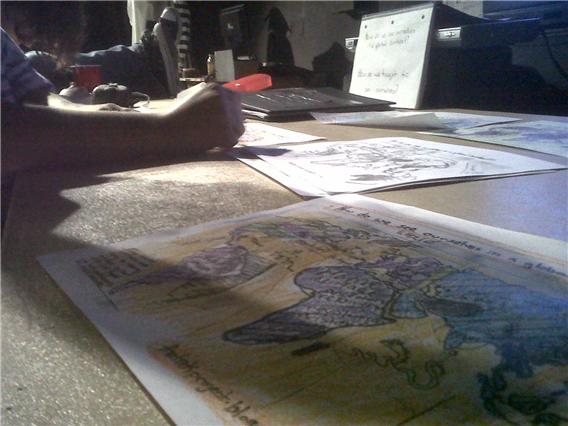
As you may or may not know on Monday I returned from Nicaragua at the end of a two-week trip where I completed the bulk of the production for The Trek Project (thetrekproject.blogspot.com). The Trek Project is a 3 part multi-media exploration of the way that we (people living in the United States) create and work within communities both at home and abroad. The first part of the project is a timeline of US-Latin American relations that will be incorporated into the final DvD. The second part is a series of Mapping Workshops and Discussions about the concept of global community, responsibility, and accountability.
Due to the fact that it was only possible for me to travel to Nicaragua with the Trek team as a single person the creation of this project, has, up until this point been primarily a solo process. I have had a number of meetings with people to discuss the project and build the concept into what it is now; however, in terms of production I have flown solo. Now I am looking for people who are interested in helping me more directly with the post-production process. I am looking for:
• Help (or continued help) with concept development
• Periodic feedback on cuts of the movie
• Help working on a soundtrack
• Help with Audio post-production in general
• Someone who can show me how to use After Effects
• Help with animation
• Help with checking Spanish-English translations
• Help creating subtitles in both Spanish and English
• Fiscal Sponsorship, or people with a head for fundraising
• Art, by independent artists (visual, digital, written, performed, or musical), that deals with issues of globalization, Latin America, the creation of communities, or any other related issues, to potentially be interviewed, speak about their art who have a piece featured in the documentary.
• Places and/or groups to hold Mapping Workshops with
If you have skills in any of these areas or know someone who does and is interested let me know! Everyone who participates in the creation of this project receives credit and a copy, for certain jobs monetary compensation might also be possible depending on the budget of the project.
***Also, I would absolutely love to have any buildOn students who are interested in the project and want to get involved in anyway.
Thank you for your continued support-
Helyx Chase
HHProductions
HHconnects@gmail.com
thetrekproject.blogspot.com
Due to the fact that it was only possible for me to travel to Nicaragua with the Trek team as a single person the creation of this project, has, up until this point been primarily a solo process. I have had a number of meetings with people to discuss the project and build the concept into what it is now; however, in terms of production I have flown solo. Now I am looking for people who are interested in helping me more directly with the post-production process. I am looking for:
• Help (or continued help) with concept development
• Periodic feedback on cuts of the movie
• Help working on a soundtrack
• Help with Audio post-production in general
• Someone who can show me how to use After Effects
• Help with animation
• Help with checking Spanish-English translations
• Help creating subtitles in both Spanish and English
• Fiscal Sponsorship, or people with a head for fundraising
• Art, by independent artists (visual, digital, written, performed, or musical), that deals with issues of globalization, Latin America, the creation of communities, or any other related issues, to potentially be interviewed, speak about their art who have a piece featured in the documentary.
• Places and/or groups to hold Mapping Workshops with
If you have skills in any of these areas or know someone who does and is interested let me know! Everyone who participates in the creation of this project receives credit and a copy, for certain jobs monetary compensation might also be possible depending on the budget of the project.
***Also, I would absolutely love to have any buildOn students who are interested in the project and want to get involved in anyway.
Thank you for your continued support-
Helyx Chase
HHProductions
HHconnects@gmail.com
thetrekproject.blogspot.com
Wednesday, July 22, 2009
Back from Nicaragua
Monday evening at about 7 pm EST I arrived in NYC back from 2 weeks in Nicaragua. The Trip consisted of about 4 travel days and 10 days in the community of Gualacatu, North of the city of Jalapa, about a kilometer from Honduras. I come back to the United States with a collection of written, photographic, drawn, and video taped representations of Gualacatu, a community that opened their hearts and homes to a group of 10 high school students from New York and Philadelphia, 2 program coordinators from buildOn, 2 New York City High School teachers, 3 Nicaraguan translators, and 1 videographer. I begin now to put together the writting, drawings, interviews and 13 and a half hours of video footage into the final project, and I begin now to insert pieces of that process into this blog, starting with this excerpt from the journal I kept during the trip:
"What becomes apparent to me as I return to buildOn is that the organization serves 2 purposes. To empower youth and to empower communities" (7-10-09)
What I mean to say here is that there is a dual purpose to the work that buildOn does, which is to balance between the work of spreading education in a global sense community by community, but also to allow very specific youth who are involved with the program in the US to empower themselves through the Trek for Knowledge experience. I know that what I saw in the students who came on the trek at the end of the two weeks was students who were strong, and had been permanently changed by their experience, an experience that they will carry with them for the rest of their lives.
To the balance between the selfishness and imperialism of aid tourism and the benefit of the work of buildOn is something that I will continue to explore both in this blog and as I move into post-production on the documentary.


"What becomes apparent to me as I return to buildOn is that the organization serves 2 purposes. To empower youth and to empower communities" (7-10-09)
What I mean to say here is that there is a dual purpose to the work that buildOn does, which is to balance between the work of spreading education in a global sense community by community, but also to allow very specific youth who are involved with the program in the US to empower themselves through the Trek for Knowledge experience. I know that what I saw in the students who came on the trek at the end of the two weeks was students who were strong, and had been permanently changed by their experience, an experience that they will carry with them for the rest of their lives.
To the balance between the selfishness and imperialism of aid tourism and the benefit of the work of buildOn is something that I will continue to explore both in this blog and as I move into post-production on the documentary.


Subscribe to:
Posts (Atom)
